The Expert insights on Foot-and-Mouth Disease, market trends, and technical strategies across Asia
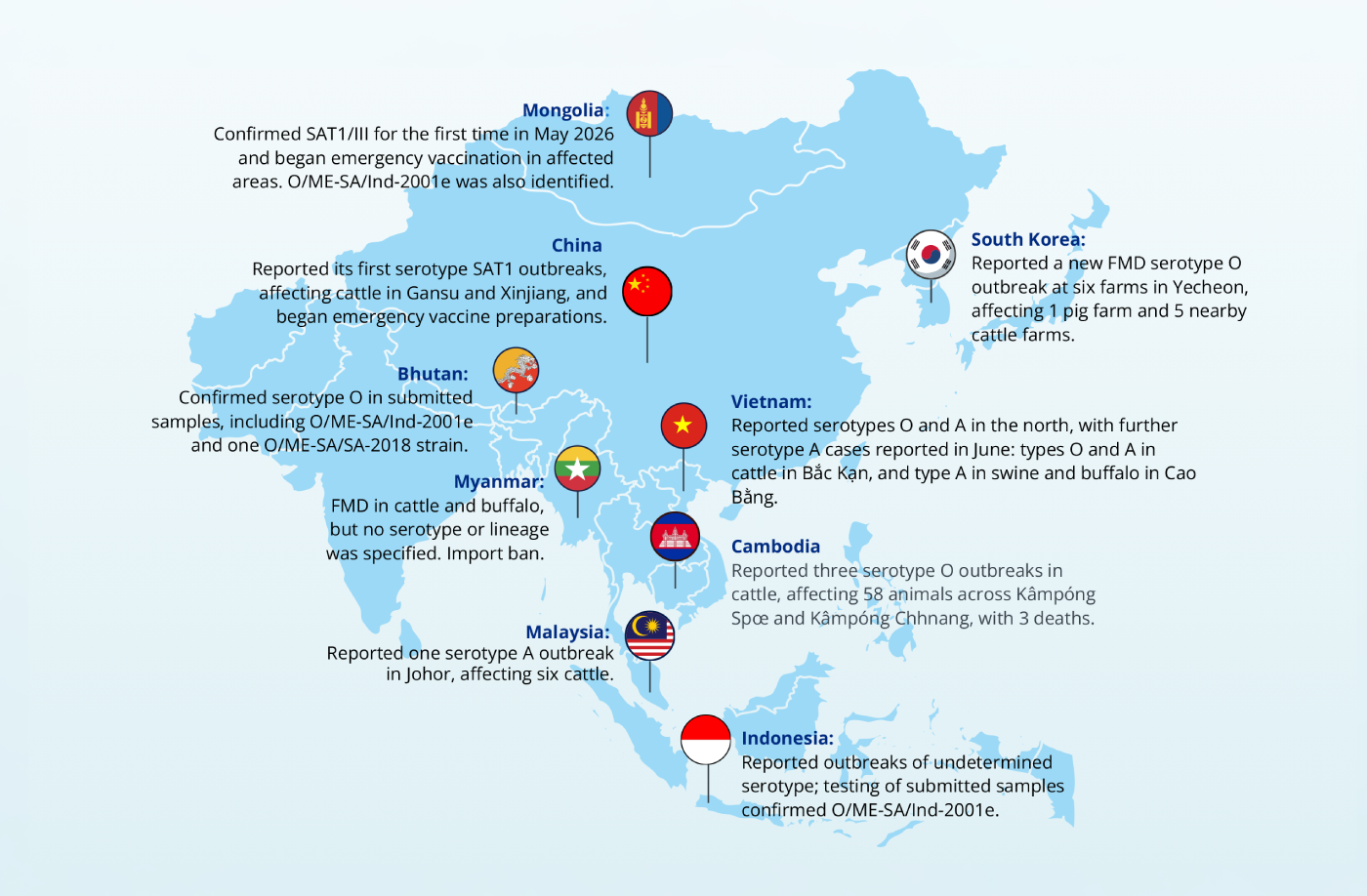
FMD activity continued across Pool 1 (Southeast, East and Central Asia) and Pool 2 (South Asia), with serotypes O and A reported in several countries, while the emergence of SAT1 represented a significant change in the regional FMD Situation.
In Pool 1, SAT1 was detected for the first time in China and Mongolia. China reported two cattle outbreaks affecting 77 and 142 animals and initiated emergency vaccine preparations. Mongolia confirmed SAT1/III and continued to detect O/ME-SA/Ind-2001e. Cambodia reported three serotype O outbreaks (58 cattle), Malaysia one serotype A outbreak (6 cattle), and the Republic of Korea a third serotype O outbreak (1 pig farm and 5 cattle farms). Viet Nam reported serotypes O and A, while Indonesia reported untyped outbreaks and confirmed O/ME-SA/Ind-2001e in submitted samples.
In Pool 2, Bhutan confirmed serotype O, identified as O/ME-SA/Ind-2001e and O/ME-SA/SA-2018 virus.
Overall, serotype O remained widespread, but the emergence of SAT1/III in China and Mongolia was the main regional concern because herd immunity and suitable vaccine availability are limited. Continued serotype A activity further highlights the need for enhanced surveillance, rapid virus characterization, biosecurity, movement controls and vaccine preparedness.
The global FMD situation in Q2 2026 was dominated by the unprecedented spread of SAT1/III from the Middle East into Europe, China and Mongolia. The lineage caused more than 200 outbreaks in Cyprus and Greece combined and affected a wide range of susceptible species, including cattle, small ruminants, pigs and yaks.
Southern Africa also experienced a separate wild-type SAT1/III upsurge involving South Africa and neighbouring countries, together with continued SAT2 activity. Meanwhile, O/MESA/SA-2018 became increasingly important in Pool 3, while O/ME-SA/Ind-2001e remained active across Asia. These developments prompted intensified surveillance, biosecurity, movement controls, culling and large-scale vaccination campaigns in several affected countries.
SAT1 continued across the Middle East. Israel and the Golan Heights reported eight outbreaks, Palestine recorded its first two outbreaks, and Syria confirmed SAT1/III. Iraq reported 83 outbreaks plus eight in Kurdistan, while Türkiye reported eight outbreaks involving O and SAT1 and vaccinated more than 2.8 million animals. Azerbaijan, Georgia and Armenia also conducted large-scale vaccination campaigns.
North and Eastern Africa (Pool 4): Libya reported five serotype O outbreaks. Egypt vaccinated almost 3.5 million animals, while Sudan and Tanzania notified isolated untyped outbreaks and Uganda announced mandatory FMD vaccination from July 2026.
West/Central Africa (Pool 5): Mali notified of one historical untyped outbreak affecting 15 cattle. No Pool 5 samples or sequences were received during the quarter.
Southern Africa (Pool 6): SAT1/III affected Botswana (22 outbreaks), Eswatini (23), Lesotho (19), Zambia and South Africa. SAT1/II was also detected in Eswatini. South Africa reported 553 SAT1 and 663 SAT2 outbreaks, while no SAT3 had been reported since March 2025. Zimbabwe sequences were identified as SAT2/I.
No new outbreaks of foot-and-mouth disease were reported in South America.
SAT1/III caused major outbreaks in Cyprus and Greece. Cyprus reported 72 outbreaks, vaccinated most livestock in restricted areas and culled more than 70,000 animals. Greece reported 123 outbreaks on Lesvos and culled more than 37,000 animals under strict quarantine, movement controls and whole-herd stamping-out.
Source: WOAH-FAO FMD Ref Lab Report April- June 2026; WAHIS
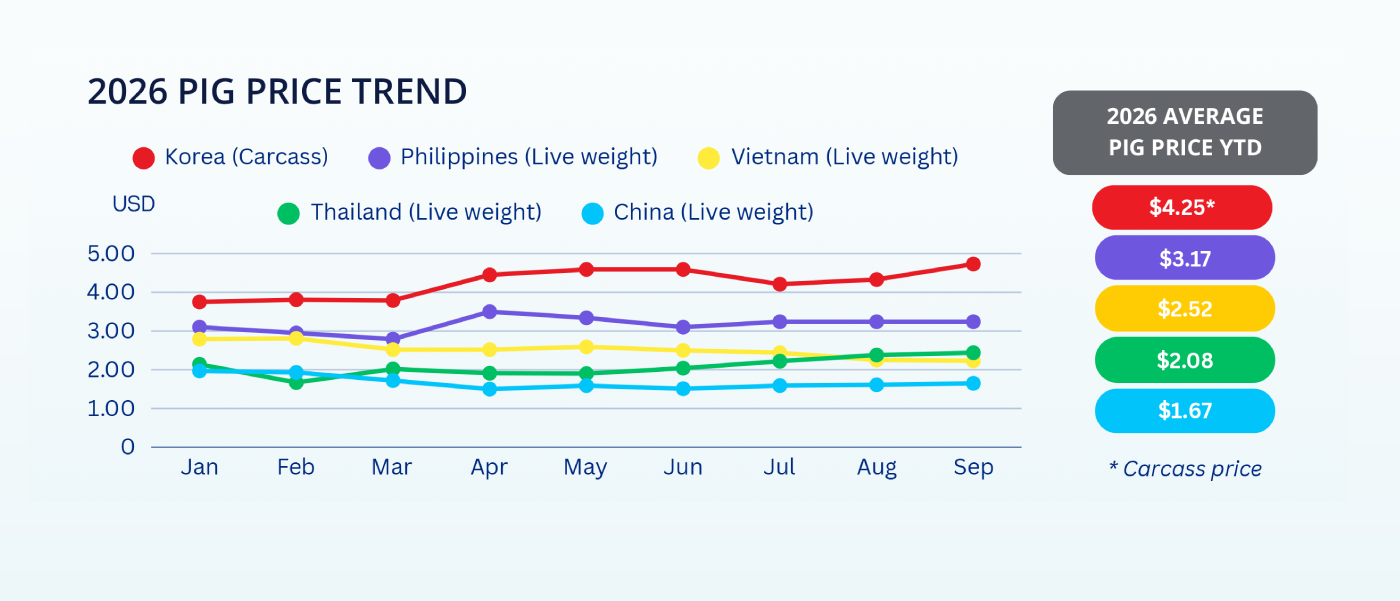
Asian pork markets remain mixed: prices are weak or softening in China, Vietnam and the Philippines due to ample or recovering supply, firming in Thailand, elevated in South Korea because disease has constrained domestic production, and weakening in Japan as demand softens, while Taiwan appears comparatively stable.
Asian swine markets are gradually rebalancing, but uneven supply, persistent disease risks, import dependence, and cautious demand continue to pressure prices and margins. Producers are strengthening biosecurity and cost control while investing in genetics, optimized nutrition, modern facilities, automation, AIoT, and data-driven management to improve productivity and resilience.
SWINE INDUSTRY NEWS & OUTLOOK
China: Oversupplied market, moving toward gradual rebalancing
China’s pork market remains oversupplied, with hog prices 33% below last year. Producers are reducing the sow herd, while authorities monitor inventories and slaughter weights. Prices may recover modestly in late Q3 or Q4, but weak demand will limit gains.
Thailand: Hog Prices Improve as Disease Preparedness Intensifies
Thailand’s hog prices improved in September, reaching THB 72–78/kg against a Q2 production cost of THB 71.76/kg. Authorities are strengthening border surveillance, laboratory capacity, and FMD SAT1 vaccine preparedness. Margins may improve if prices hold, but disease, feed costs, illegal imports, and regional supply remain key risks.
Vietnam: Growing supply with persistent disease and margin pressure
Vietnam’s hog prices are softening as supply grows, while higher costs and ASF pressure farm profitability. Smaller producers are exiting as larger farms invest in genetics, biosecurity, and modern facilities. Production will likely rise in second half of 2026, weighing on prices, but lower input costs may support margins.
Philippines: Recovering production but still import-dependent
Philippines’ pork production is recovering, but the herd remains below last year and imports still cover supply gaps. Authorities are supporting herd rebuilding and vaccination, while importers diversify through Brazil and Spain. Imports will remain strong, with domestic prices gradually recovering as the herd rebuilds.
South Korea: Disease-constrained supply supporting prices and imports
Disease losses have reduced slaughter and raised pork prices, while demand remains weak. Producers are managing inventories and promotions as importers diversify toward European pork. Imports should stay strong until production recovers, then prices may ease in second half of 2026.
Japan: Softer consumption with rising import requirements
Japan’s pork demand has weakened since mid-May amid inflation and a weaker Yen. Importers are sourcing more affordable pork from the US, Canada, Brazil, and Mexico. Imports are expected to rise, while summer heat may reduce domestic production and weak demand may limit prices.
Taiwan: Stable sector under heightened biosecurity
Taiwan’s commercial pig sector remains stable, with no ongoing ASF circulation reported. Authorities have tightened border controls, farm surveillance, and movement management after ASF-positive carcasses were found near Kinmen. Production remains stable, while export growth depends on disease control, market access, and competitive pricing.
Source: Compiled and summarized by Biogénesis Bagó Asia